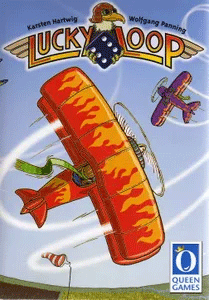
Lucky Loop is a 2003 Queen Games title by Karsten Hartwig and Wolfgang Panning, with art by Christof Tisch. On BoardGameGeek it sits as a family dice game about air-show stunts: loop, turn, dive, roll. You build four set routines, then finish with a freestyle pass. Harder cards score more. Miss a roll and that routine dies on the spot.
It is not an online slot. It is still a luck-and-risk game, which is why it fits this site. You choose the difficulty. You spend a limited dice pool. You decide whether the next attempt is worth the miss.
Lucky Loop at a glance
| Detail | Spec |
|---|---|
| Designers | Karsten Hartwig, Wolfgang Panning |
| Publisher | Queen Games |
| Year | 2003 |
| Players | 2 to 6 |
| Age | 8+ |
| Time | about 45 to 60 minutes |
| Type | Dice, push-your-luck, light set collection |
| BGG page | boardgamegeek.com/boardgame/8127/lucky-loop |
In the box: 1 board, 64 flight cards, scoring stones, chips, 7 dice (6 black, 1 red), a cup, and the rulebook.
The board is a score track in the middle and four flight paths around the edge. Each path wants a three-card colour combo. Cards show a colour and a difficulty from 3 to 12.
How Lucky Loop plays
Each player starts with a colour, score markers, a highlight chip, and a six-card hand (three from each draw pile). One player keeps the start-player marker for the whole game so everyone gets the same number of turns.
On your turn you do one of two things.
Swap cards. Draw three cards, looking at each as you take it and mixing the two decks if you want. Then discard three from your hand. This is how you hunt a colour set you can actually fly.
File a flight plan and fly it. Play a full three-card routine onto an empty path (colours must match that side of the board), or replace one card already on a path with a same-colour card of higher value. Then you fly.
The dice loop
A flight has three rolls. You have six black dice in total and may roll at most three at once.
- Roll up to three dice.
- Assign one, two, or three of them to one open card so the sum equals or beats that card’s number.
- Exact match scores better than going over. Over still counts as a made figure, just with a weaker payout.
- Fail to cover a card and the whole routine ends immediately.
You repeat until all three cards are covered or you bust. After the second successful roll you may quit on purpose if the last target is ugly and your remaining dice cannot reasonably hit it.
That last rule is the whole game in one sentence. Lucky Loop rewards courage. It also punishes people who treat every leftover die like a promise.
Scoring and the bonus chips
Made figures score from the printed difficulties. Higher cards mean more points and a thinner chance of hitting. If you post the best result on a given path, you take a bonus chip. Those chips matter later.
Players can come back to the same path and try again. Your final score on that figure is what you keep, so a timid first pass can be upgraded if you are willing to risk the dice again.
The freestyle (the Kür)
After the four set programs comes the free routine. You build your own line, usually three to six cards, with a high minimum total (reviews put that floor around 25). You pick the length. You pick the heat.
Fail a freestyle attempt and you lose points. Succeed and you can dump a big finish on the track. The red die is a special tool in the main show. You generally cannot buy it back with a bonus chip once you are in the Kür. Plan for that.
When the freestyle is done, finish the round so everyone had the same number of turns. Highest score wins the air show.
What the game is actually about
Lucky Loop looks like a kids’ flying theme. The decision is adult and familiar to anyone who plays casino games.
You set a target. You spend a limited pool. You choose exact-value precision versus “just clear it.” You decide when to walk.
That is the same fork you hit on a hot slot feature or a live bonus. If you want the casino version of this habit, read exactly how to ride a hot streak and actually cash out and casino luck is not random. Dice are not an RNG slot, but the brain error is identical: a near miss feels like the table owes you another attempt.
Strategy that actually helps
Build the path before you show off. A pretty 12 that you cannot cover with three dice is dead cardboard. Swap until the colours and the numbers fit the dice you still have.
Exact beats overshoot. The rules pay a clean hit better than a sloppy clear. If you can make a card with one die instead of two, save dice for the next figure.
Stop after roll two when the math is ugly. One die left against an 8, 9, or 11 is a donation. Take the partial score.
Do not raise a path just because you can. Replacing a card with a higher same-colour value is how you steal a bonus chip. It is also how you turn a makeable line into a bust.
Save chips for the moment they change a roll. Bonus chips are not victory points by themselves. They are insurance for a tight third figure.
Treat freestyle like a bankroll rule. Set the card total you will accept before you lay them down. If the first roll misses, eat the penalty and stop digging.
The same discipline shows up when you pick slot volatility. High numbers are the high-volatility path: dry, then a spike, or nothing. Lower cards are the low-volatility path: smaller scores, fewer busts. That split is unpacked in strategies to beat slot volatility and strategies to maximize winnings on slots.
Lucky Loop versus online casino games
Lucky Loop gives you information a slot will not. You see the target. You see the remaining dice. You choose the card. A certified slot hides the next result and keeps the house edge in the paytable.
If you bounce from this table game to a casino lobby, check the math first. Use RTP explained and the top 10 highest RTP slots for 2026. Current and older hit lists are the most popular slots of 2026 so far and the most popular slots of 2024. Jackpot games have their own tax. Read how progressive jackpot slots work before you treat one like a regular reel game.
Interactive and live titles that keep a “one more pass” feel live in top 5 interactive casino games and top 10 best live casino games in 2026.
Bonuses on those sites are extra attempts, not a better percentage. See understanding casino bonuses and why even the best casino bonuses cannot beat bad luck.
Play only on operators that pass a basic safety check: choosing a safe online casino in 2026 and scam casino red flags. Dutch readers who want play without CRUKS can use the Zonder CRUKS guide.
Luck stories outside the table are still just stories: World Cup luck predictions, zodiac cold streaks, Arsenal vs Chelsea, the LUCK stock, Farage’s crypto gift. None of them change a d6.
Who should put Lucky Loop on the table
Play it if you want a loud 45 to 60 minutes for mixed ages, you like Yahtzee-style allocation more than heavy euro engines, and you enjoy watching someone go for a 12 with two dice left.
Skip it if your group hates swingy endings. The freestyle can flip a careful game. Two players works. Four is the sweet spot in most reports. Six makes the wait between flights longer.
The theme is thin. The tension is not. You built the routine. You knew the number. The dice still get a vote.
Verdict
Lucky Loop is a clean push-your-luck show. Four compulsory figures teach the dice economy. The freestyle asks whether you learned it. That is the game Hartwig and Panning published, and that is the page on BoardGameGeek: Lucky Loop (2003).
Choose the routine. Spend the dice. Bank the score. Do not fly the last loop just because the crowd is watching.